Thursday, April 27, 2017

Energy. Ambition. Love. Grace. PART I: ENERGY

In celebration of Cherie Mason: an exemplar of the Opera House mission to use the performing arts to create excellence in all the way we perform our lives.


Part I of a 4-part series on the life and distinguished career of Cherie Mason, based on a 2016 interview with Judith Jerome, founding co-artistic director of Opera House Arts.

Part I: ENERGY
“When my mother put me to bed at night, she would open the door after a little while and say, ‘Cherie, are you sleeping? What are you doing?’ And I would say—‘I’m having a play.’ I remember those words distinctly: ‘I’m having a play.’ And I was, as I went to sleep, having a play. . . And doing all the parts.”

Our first burst of laughter fills Cherie’s dining room. It’s an afternoon of laughter and tea, the tape recorder running. Cherie Mason delivers a line with impeccable timing—and  knows herself well.

She dramatized storybooks, and would “drag my little neighbor children in. I had a book on Snow White and the Seven Dwarfs, and so I picked seven poor little children, my buddies, for each of the dwarves—and I of course was going to play the lead. After a few minutes they were very bored with this idea and didn’t want any part of it. And I just stamped my foot and said, ‘We are going to rehearse this tomorrow and you’d better show up.’ Well they didn’t show up. So that became a problem. I don’t know how that ended . . .

I, Judith speaking now, had plays, too; also circuses. I dreamed a real trapeze, hung in the sky. Mary McGuire told us years ago how she and her sister and their friends would for weeks after seeing a traveling show at the Opera House perform and re-perform it. From where does such wonderful personal arrogance in a child arise? Eschewing expertise, embodying amateurishness, in the sense of working from love and ownership—to take something into your body and know you can do it? To put up the posters and invite the neighborhood and charge the nickel? How does a life in theater begin? And what are the paths it takes? In Cherie Lee’s case they were multiple. Mimicry is basic to how we learn the world, but what is the impulse behind performance?

“As a child I lived in Milwaukee, WI, and that was certainly not a mecca for theater. But I vividly remember my first experience. The musical, Oklahoma, came to Milwaukee and my mother allowed me to buy a ticket—we never had a lot of money, but she was so good. I was in peanut heaven! I was so swept away by that musical that [at the end] I was frozen in my seat, and people all around me were leaving. I couldn’t move. And I didn’t move until they were turning the lights out on the stage, and the house was going dark. And then finally I got up. And I’m not sure I ever got over that—and I’m not sure that I have ever had more of a reaction to anything in my adult life. I thought, oh, wouldn’t that be wonderful, to be on that stage! But it never occurred to me that I ever could be.”


Anni Lee (nee Wernitznig) was Cherie’s unstoppable, slightly outrageous, mother. Who was she to be able to lay the groundwork to support this daughter’s energy, ambition, and grace? Anni, too, had her moment in theater. The Pabst Blue Ribbon company “had an auditorium right near the center of town, and my mother in her early days—she was one of the first women to bleach her hair; she was really a flapper, I’m afraid. One of those. She was in a swing once in a stage production of the Pabst Theater. She was swinging and singing on stage. She was VERY proud of that, and was quick to tell everyone that she had been on the stage. So I inherited the stage—and inherited the bragging!”

Anni raised Cherie on her own, and theater was not a regular part of their lives; the ticket to Oklahoma was a one-time treat. But Anni had the fancy that Cherie should be a ballet dancer, so she enrolled her in lessons. “A Russian lady taught the ballet classes. She had a long Russian name, and taught in a beautiful rehearsal hall, surrounded by mirrors—it was quite elegant!—but you had to do your homework!  You had to learn a tour jete and all these things—but where was I going to do it?! We lived in this crummy little apartment building, with narrow halls—I think they were about 4’ across. Well, I practiced in the hallway. I would pray to God that no one opened a door—in the middle of a tour jete—as I was flying by! Fortunately no one ever did.” But it was embarrassing, somehow, practicing in the hallway. “Also, it just didn’t seem like the way I was supposed to go.” She informed Anni. “I think that was the same week I dropped a watermelon in the elevator.”


After she graduated from high school Cherie lived at home and for the first year attended Marquette University. “But then I couldn’t stand it, and I decided that I just had to go to Northwestern University [in Chicago], because that’s where all the theater was. Northwestern had a wonderful speech department. Paul Lynd and Charlotte Rae (also from Milwaukee) were graduates. And Cloris Leachman. These were all just icons to me. So I applied for a scholarship to Northwestern, and I got it! I lived with a family and did their cooking, and took care of their children.” And carried a full load at Northwestern. The trouble with being a theater student is that productions in non-conservatory programs are outside coursework—you have to do them in your spare time, and Cherie didn’t have any spare time. “So it was a mixed blessing—to have all that in front of me but not be able to participate.”

 Nor did a direct road to theater open up to her after graduation. When she transferred to Northwestern it was with the idea that her credentials from such a prestigious program, plus the contacts she made there, would provide an automatic entre. But it didn’t turn out to be so—and her financial situation required that she earn a decent salary at once. She had been doing radio and voice work in school, in the Speech department. She found an ad in Broadcast magazine. “Radio stations that were looking for help took out ads there. And that was how I got my first job!” But not right away. Anni called from Milwaukee and said, “You’ve got a letter here, somebody from a radio station in Texas.” “And I said, well open it! And it said, ‘Come and talk to us!’ In Texas! I thought how am I going to do this. But of course Anni encouraged me. So I got on a bus and went down to Texas, to Austin, and I remember sleeping in the basement of the YWCA. We all had little cots, and that’s how I could afford to make the trip. Well, they were happy to see me, but they said, ‘We didn’t promise you anything, and we just don’t have anything right now.’ So now I’m stuck down there. And I don’t have any money. And my mother gets another message, and this one is from Montana: a 250 watter [the minimum wattage to get a radio station on the air at that time], in the heart of the Judith Mountains, in Montana. This was a legitimate job offer for $32.50/week.” Cherie took the job and got to Montana by sleeping on a Greyhound bus, loaded with cowboys. The cowboys called her ma’am and invited her to meals, “and I’d say, oh yes, thank you, yes.” With her disarming grace. “And if I was afraid of any impropriety—I’d sit up in front with the driver; there was always a seat opposite him—so that’s how I made my way from Austin to Montana.


“I didn’t even go home. I was afraid the job would be filled. I thought if I don’t get there in time they’ll give it to someone else. So, anyway, that was the beginning!

Monday, November 28, 2016

Mind the gap


In my early 20s, I lived in a house with four wonderful women. We were all theatre artists, had all moved to DC after graduating college, and were all working different survival jobs while we pursued our dreams. We kept each other sane: cheered each other on through success, consoled each other through challenging times, and hosted the best parties.

There was, of course, a fly in the ointment.

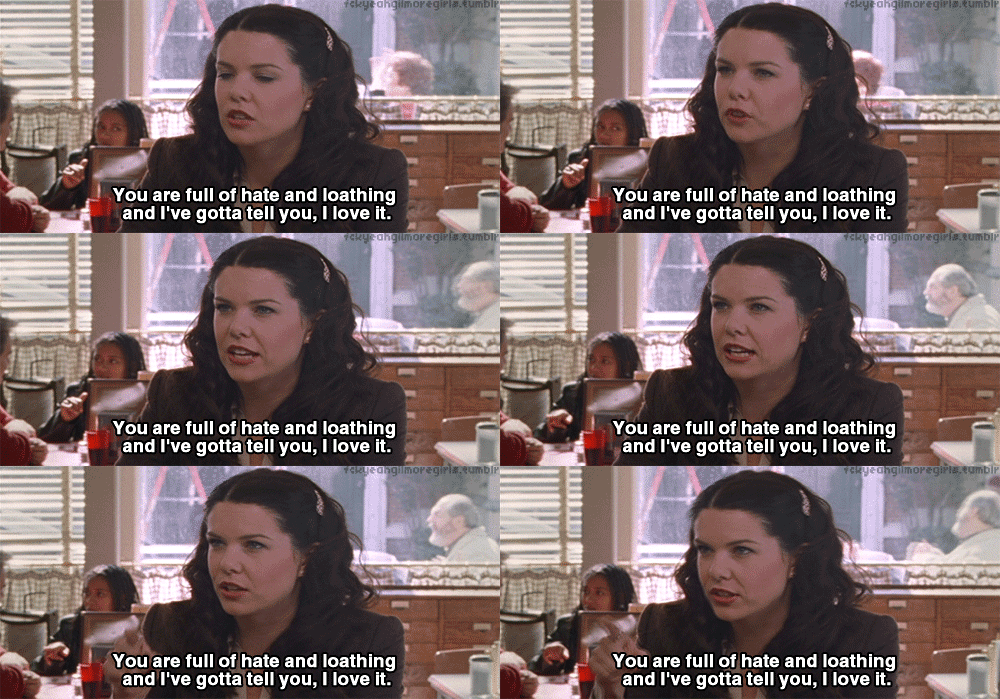
My roommates, all of them, loved The Gilmore Girls. Not just liked it. Loved it. Many a Saturday morning was devoted to binge-watching whole seasons of the TV show, enjoying the heart-warming and witty banter of its protagonists as they lived their lives in the mystical and Hallmark-esque town of Stars Hollow, Connecticut. Saturday mornings being a great time for lazy camaraderie, I would frequently try to join these watching sessions.

Here’s the thing. I hate The Gilmore Girls. That might not be strong enough. I loathe them. I despise them. Even just thinking about the show, I find myself getting riled up.

Which is fine, right? It’s a TV show. My friends love it. I don’t. That should pretty much be the end of it.

It’s not. My emotions about the show don’t allow me to have a live and let live approach with it. When I learn that a friend loves it, I become a little irrational about it. How can a person I love find something so odious to be good? Worse, how can I person I love – how can that person love something I hate?

All this to say, as I spend time in the rehearsal room this week, working on our staged reading of ‘Art’ by Yasmina Reza, I am finding some deep resonances to the work. When Marc says that his sense of self is shaken by Serge’s love of his white painting, I can hear my own disbelief over a friend choosing to spend time with the denizens of Stars Hollow.

At this particular moment in our history, though, I don’t need to look to an early 2000s TV show to see reflections of Marc and Serge around me. The political arena has poured itself into our personal lives, shining a light on places of disconnect between us that we never previously acknowledged. And this new illumination reveals facets of ourselves that make us uncomfortable.
If I’m who I am because I’m who I am, and you’re who you are because you’re who you are, then I’m who I am and you’re who you are. But if I’m who I am because you’re who you are and you’re who you are because I’m who I am, then I’m not who I am, and you’re not who you are. 
~Ivan
A friend of mine recently posted to Facebook that he was so distraught at learning a friend of his voted for Trump that he was re-evaluating both the friendship and his sense of who he understood his friend to be. Other friends – on both sides of the political spectrum – shared their trepidation about going home for Thanksgiving and the political conversations that would arise over the holiday dinner table. In dialog, on social media, and in comment threads of news articles, we can see the gap between who we think we are and who our actions reveal us to be.

In ‘Art’, Serge has bought a painting Marc hates, and it drives a wedge between them. Absurd? Yes. But very very familiar as well.

How do we engage with those closest to us about differences of belief in ways that continue and deepen our relationships rather than shattering them?

Join us this weekend as we tackle this tough, funny, absurd, entirely human play.

'Art' plays Dec 2 at 7pm and Dec 4 at 2pm in the Stonington Opera House.
Each performance will be followed by a community conversation.


Tuesday, August 16, 2016

Sitting down with Sarah Gazdowicz

OHA's Director of Engagement and Development, Amy Kyzer, sat down with Mr. Burns, a post-electric play director Sarah Gazdowicz to talk about the show. Here's what Sarah had to say:


What specifically about this script and this season of Opera House Arts Main Stage productions were you drawn too?

'Mr. Burns' is an undeniable challenge. There are so many moving parts to it logistically and the play's rich content is not easily mined on a first...or second...or third pass.  To be frank, I found the play more than a little frightening, but I also found it incredibly fascinating.  Why turn down opportunity to push yourself and grow as an artist? 

What is the connection from your piece to our island and situations that affect us on a larger scale?

An important element of 'Mr. Burns' is how groups or communities of people evolve and persevere through the passage of time.  The island, and the Opera House itself, is a place and a community that has grown and changed a great deal even in only the last few decades.  The recognition of history along with the need for change is a balancing act that people from or who have had a long relationship with this island must understand very well.

What was your preparation leading up to auditions and now entering rehearsals?

Read the play. Consider what elements are necessary to fully illuminate it's story and characters. Ask questions. Talk to designers and collaborators about the play. Read the play again. Research. Ask more questions. Read the play...

What outside sources are you utilizing as research to assist you in your creative process?

I have done some research on 'doomsday scenarios' especially those pertaining to pandemics and the effects and circumstances of nuclear meltdown. I watched a lot of pop music videos, refreshed myself on some Simpsons' episodes including the 'Cape Feare' episode and watched films such as Martin Scorsese's remake of 'Cape Fear'. I listened to a lot of Gilbert and Sullivan. I was particularly inspired by a wonderful novel called "Station Eleven" by Emily St. John Mandel.

Will our audiences have had to read the script to understand the play?


I think the cast and crew of 'Mr. Burns' would agree with me when I say that the play is better understood when it is seen rather than read, so much is dependent upon what a production chooses to build with the text.  I will say, however, that in either format, the play really requires you to listen and come in with an open mind. You will walk away with a lot of questions but, isn't that part of what art is supposed to do?


Get your tickets to Mr. Burns today!

Thursday, June 23, 2016

Q&A with ORLANDO director Natalya Baldyga

A Q&A between OHA's Director of Development & Engagement Amy Kyzer and Orlando's director, Natalya Baldyga:

What specifically about this script and this season of Opera House Arts Mainstage productions were you drawn too?
Orlando was compelling to me because of the way that it combines storytelling, wonderful language, and the possibility for physical theatre. I find the story of Orlando (in both Virginia Woolf’s novel and Sarah Ruhl’s play) to be extremely moving, while at the same time not taking itself too seriously. There are equal parts poignancy and humor. I enjoy that Orlando makes a statement about how we view gender, but I’m particularly affected by the main character’s journey through life. The play reminds me that we experience the act of living differently at different stages in our lives, and that there are sometimes no words that can do justice in describing what means to be alive in the world.
I love how the season pairs classical and contemporary plays together in order to ask a central question – how do you respond when the world is changing around you?

What is the connection from your piece to our island and situations that affect us on a larger scale?
I’m just getting to know the island, so I don’t want to make any assumptions, but something that might resonate with audiences is the profound connection that Orlando has to home. The character has many adventures and some exciting travels, but always returns home to regain a sense of self. 

What was your preparation leading up to auditions and now entering rehearsals?
Leading up to auditions, I spent a lot of time thinking about what kind of actors I needed for this play and especially the qualities that I was looking for in the lead actress. I needed actors who were comfortable playing both men and women, who could move well and who handle language well. I also was looking for actors who would be good in an ensemble piece like this one, and who seemed like they would be fun to work with. We have a small number of actors who play all the roles – they have to work well together to create a cohesive world.
Now that we’re in rehearsals we’ve been doing a lot of movement work with Danny McCusker, who is doing the choreography for the show. We don’t have any dancing, but we do have moments when the cast helps to create the world of the play through movement. The physical work that Danny has done with the actors has given him the building blocks to start creating some of the choreographed moments of the show.

What outside sources are you utilizing as research to assist you in your creative process?
Other than images of the historical elements of the costuming, we’re relying primarily on Virginia Woolf’s novel, Orlando, on which the play is based. The novel has given us insights into characters and specific moments in the play, really allowing us to flesh them out.

Will our audiences have had to read the script to understand the play?
Absolutely not! Some audience members might enjoy knowing the story of Orlando in advance, but audiences should be able to walk in without any advance preparation and still have a good time. You can either walk in thinking, “I know this story – I wonder how they’re going to make it happen?” or walk in thinking, “I wonder what the story is?” Both should be equally fun.

Friday, June 17, 2016

Art makes the world slow down

 I’m paraphrasing Diane Paulus, artistic director of the ART, in her opening plenary address to the annual Americans for the Arts Conference, today in Boston. Art is antidote to information overwhelm. It causes us to pause, and in the best of circumstances to be present—and to go deeper than the surface of an idea, a feeling, or an event. If the theme of this OHA season has to do with how we deal with a world spinning too quickly, Paulus has one answer.

Echoing in many ways Orlando director Natalya Baldyga’s beautiful and passionate post three days ago, Paulus begins by telling us that the speech she had been planning radically changed last Sunday in the wake of the shootings in Orlando. “I make theater,” she says, “because it is a forum to ask questions. To live inside questions. To push boundaries with questions. To provoke with questions. “ She tells young directors, “If the theater you create is banal, it is most likely because you have not asked a big enough question.”

Paulus’ tenure at the ART, like Rob Orchard, Polly Carl, and David Dower’s at ArtsEmerson, like Melanie Joseph’s at Foundry Theater, and on and on, has been signally engaged with how to get the big questions in the water, to get them to live in the staff and artistic teams, in the audiences, and those who don’t usually come to theater, those who we in theater are often talking about. Those of you who know the Opera House know that that was the OHA founders’ goal as well, in the post-show conversations, invited rehearsals, and Shakespeare-in-Stonington reads, and in general the commitment to listening to our community, making work that responds to this community. I am moved and heartened by the new additions and directions in which Meg Taintor, the new Producing Artistic Director at the Opera House, is taking these efforts.

Here are a few of them: Preparation for the summer season begins with sit-down read-throughs of the season’s plays. You are invited. Next, Page One conversations are held with each director, to apprehend their vision, their big questions, to—get everybody on staff on the same page before the rehearsal process begins, to understand how to market the shows, to understand to whom to reach out, to whom to ask questions. The whole staff attends, and community is invited. YOU are invited. To read, to listen, to ask your big questions.

This week there was a sneak-peek at an Orlando rehearsal. YOU were invited, and will be again. Come! And if there is any question about how theater slows time down, observing just this one thing: how in rehearsal a gesture is taken apart, again and again and again, to make it visible in terms of sight lines—can everybody see this!?—and visible in terms of what it communicates, to the other actors, to the audience, about the character—will answer that question. Liz Rimar is sublime in giving us a turn of the wrist that is at one moment male and in the next female, whatever that means. Feel how that sets loose something in your gut.

Paulus, in her also Harvard role these days, actually begins the remark about time slowing down by talking about how college offers this to young people. Scholarship, at many levels, offers it to us all. Pausing . . . to think things through, to find out what we mean.

Shout out to Linda Nelson who at this very moment is at the Americans for the Arts conference and texted me to say: Watch this now! You can watch Paulus’ speech on Youtube (Diane Paulus, Opening Plenary: Arts and Engaged Citizenship—but you’ll need to skip to hour two, precisely, past the welcomes and awards), and I cannot recommend it enough.


Tuesday, June 14, 2016

On directing a play called ORLANDO

A note from director Natalya Baldyga

When I accepted the invitation to direct Orlando, Sarah Ruhl’s charming and poignant play, the title had two associations for me. The first was Virginia Woolf’s novel, from which the play is adapted, and the second was a city that I knew fairly well from my time as a professor in Florida. Although Ruhl’s play features a protagonist who changes mysteriously from a man to a woman, and who experiences desire for both men and women, I was more focused, as we entered rehearsals, on how the play explored the multiple identities we embrace as we move from young adulthood to mature middle age. I did not see myself, or the production, making a bold statement about same-sex attraction or relationships. “Let biologists and psychologists determine,” says the play, quoting Woolf directly – that is, let others attempt to analyze why these things exist – it is enough for us to accept that they do.

All this changed on Sunday, June 12, 2016, when I woke to the hideous news of the mass murder at the Pulse nightclub in Orlando. Like so many, I sent a message to a loved one, “Please check in.” Thankfully, that former student, now a professor at the University of Central Florida, was safe. Social media informed me that those I know who live and work in the city – other former students – all vibrant, young, and dear to me – were safe.

So many others were not.

I can no longer hear the name of the play that I am directing without new and painful associations. It bears the weight of the innocent dead. Of the fear and hatred that could lead a person to coldly murder so many of his fellow human beings, most of them young people with their futures ahead of them. All because of a fact that he could not – would not – choose to accept: that men have loved men, and women have loved women since time immemorial. That gender and sexuality have always resisted, and will always continue to resist, simple binary definitions. That love will continue to defy hatred, misunderstanding, and even atrocity.   

Virginia Woolf wrote Orlando as a love letter to another woman, Vita Sackville-West, who was herself a prominent writer. Sarah Ruhl’s adaptation retains the novel’s passion, its longing, and the intense beauty of its language, all of which were inspired by the romantic feelings shared by Woolf and Sackville-West. It is no longer enough for me that we merely accept this great love as a fact. Our production, Orlando, must embrace that love. Our production, Orlando, must celebrate that love. Our production, Orlando, must proclaim that love.

Whether theatre can change the world, I do not know. Whether it can change minds, I do not know – although my most fervent hope is that it can. What I do know is that art – at least the art that I love – demands that we pay attention, that we ask questions, that we challenge as much as we inspire and delight, and that, above all, we never take the act of living for granted.

Natalya Baldyga
Stonington, Maine
June 14, 2016